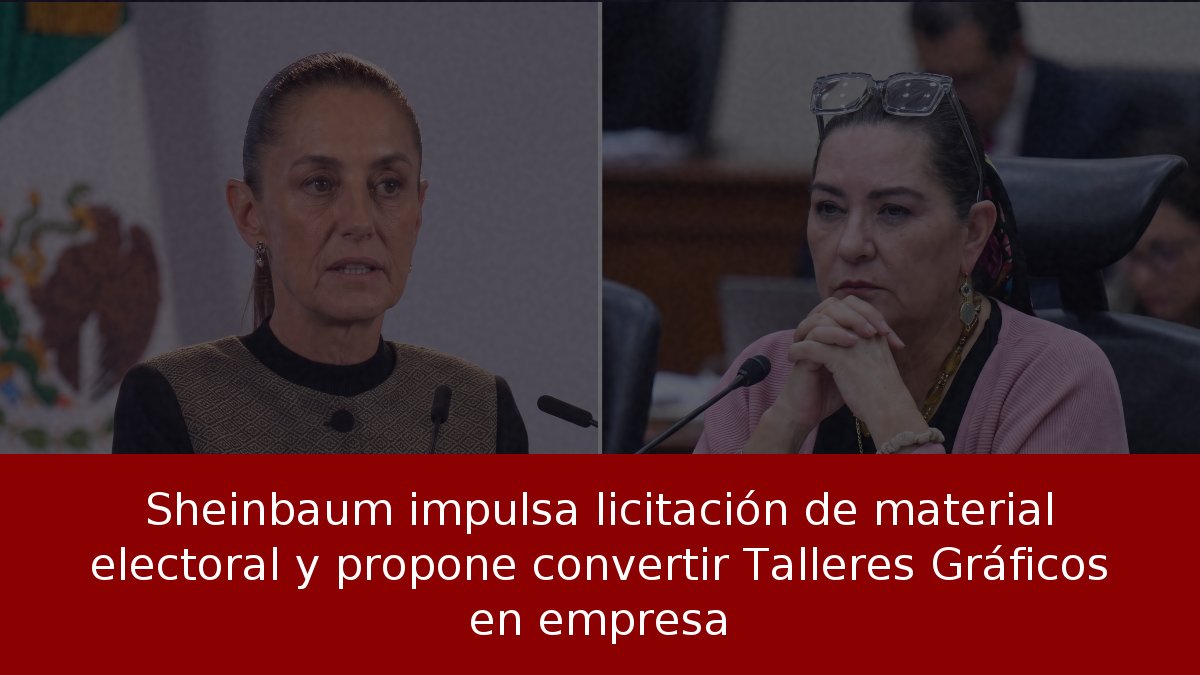
Mexico's president, Claudia Sheinbaum, said her administration is drafting a plan to turn Talleres Gráficos de México into a company with a board of directors and external oversight, so that it can produce most of the supplies used in elections. The move follows the controversy surrounding the former head of the National Electoral Institute (INE), Guadalupe Taddei.
- Core proposal: make Talleres Gráficos de México a firm with a board and outside observers to manufacture electoral materials.
- Ongoing probe: the Federal Superior Audit Office (ASF) was asked to review alleged irregularities and the awarding of ballot-printing contracts.
- Contracting overhaul: the aim is to change how these supplies are purchased, given that a handful of firms have won most contracts for over two decades.
A different contracting model
The plan seeks to alter the way these inputs are procured, after complaints that contracts have been concentrated among a small group of companies. It also calls for examining the alleged irregularities attributed to the former INE chief and for investigating how ballot-printing contracts were assigned. To that end, the ASF has been asked to step in, carry out the relevant audits and determine any possible liabilities.
Speaking at the mañanera del pueblo press conference on October 29 at the National Palace, the president said the proposal will be presented next week. She cautioned, however, that any change to electoral laws must be assessed because the electoral process is already underway, which she described as a constitutional constraint on making changes in this area.
Allegations against intermediaries
In her remarks, Sheinbaum argued that the problem is not limited to the alleged anomalies at the electoral body but also involves companies that, for more than twenty years, are said to have monopolized the awards for producing electoral materials.
“Hay un problema que es todavía más grave desde mi punto de vista, y es estas empresas que tienen más de veinte años, que son verdaderos coyotes y que pedimos a la Auditoría Superior que haga toda la investigación, que son las que se han dividido los contratos de la papelería electoral por años y se han convertido en duopolio o triopolio”, she said at her morning conference.
According to the account, some of these firms may have acted as intermediaries, not necessarily employing their own workers, and then subcontracted other companies to manufacture the products. This arrangement is said to have prevailed at both the INE and state electoral bodies, with precedents dating back to 1999.
Expanded role for Talleres Gráficos and more suppliers
Against that backdrop, the proposal aims to give Talleres Gráficos de México a larger role in producing supplies, including ballot paper, vests for institute staff, voting booth screens and materials used at polling stations.
On the possibility of amending legislation, Sheinbaum acknowledged that its legal feasibility must be analyzed before proceeding.
“Yo dije aquí el otro día que tiene que evaluarse porque la Constitución establece que no puede cambiarse las leyes electorales ya en el proceso electoral y el proceso electoral está abierto”.
The initiative also proposes opening contracting to more suppliers, on the grounds that many companies in the country are capable of making these products. Meanwhile, the ASF is to investigate the alleged irregularities and determine, based on its audit findings, whether any responsibilities should be established.
The announcement puts the relationship between the electoral body and its suppliers at the center of debate, at a time when any regulatory adjustment faces the constitutional limit of an ongoing electoral process. The outcome will depend on the proposal to be presented next week and on what the ASF reports about contract awards.