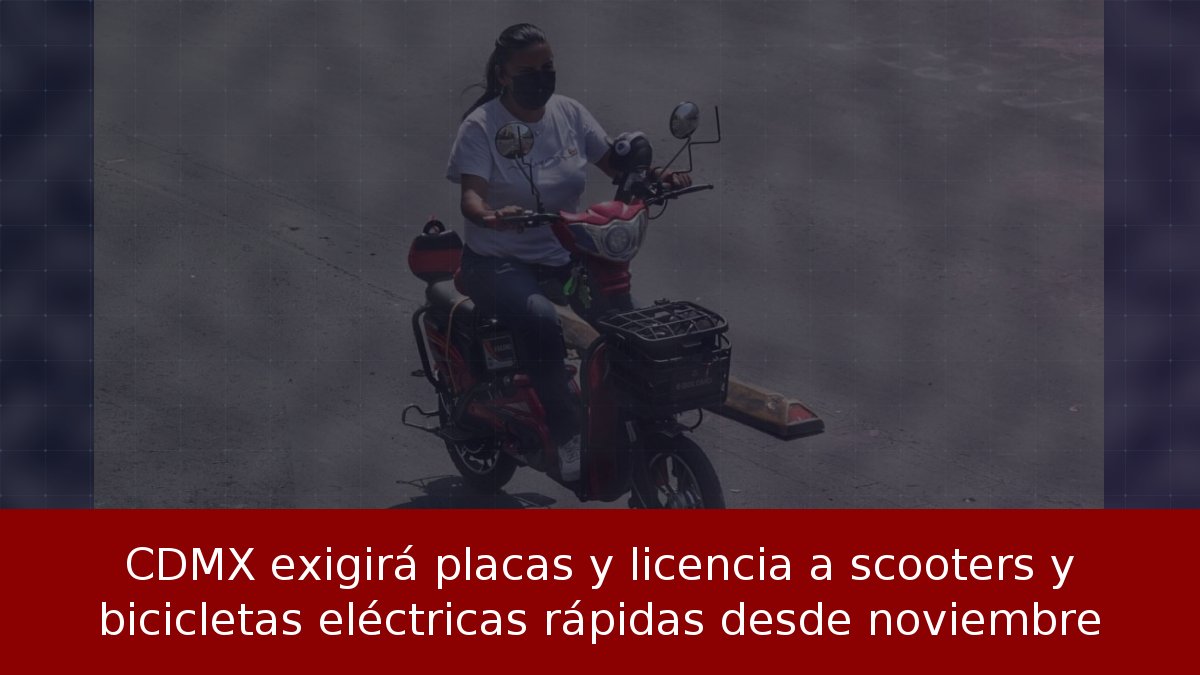
Starting in November, Mexico City authorities will fine personal electric mobility vehicles (VEMEPE) that lack license plates. The Secretariat of Mobility (Semovi) and the city government confirmed that electric or motorized bicycles and scooters must be registered, and that drivers must hold a valid license.
- Which vehicles are covered: Only scooters and electric bicycles that exceed 25 km/h and weigh more than 35 kilograms require plates and a license.
- Regularization deadline: Units bought before July 1, 2026, have until November 20, 2026, to complete the process and avoid fines.
- Fees: Registration costs 709 pesos; an A1 license costs 572 pesos and an A2 license 1,142 pesos.
- First offense: Riding without plates or a license carries a fine of 10 UMA, about 1,130 pesos.
Classification decides who needs plates
Not every vehicle sold as a scooter or electric bicycle is automatically subject to the rule. The Mexico City government classifies these units by top speed and weight, so owners should check their model's technical specifications before starting any procedure.
Scooters and electric bicycles that go faster than 25 kilometers per hour and weigh over 35 kilograms must circulate with plates and a license in the capital. The regulation aims to bring order to low-speed motorized vehicles and set identification rules for their drivers.
VEMEPE are defined as units with a motor between 250 watts and one kilowatt, an independent accelerator, two or more wheels and the ability to exceed 25 km/h. The rules split them into two types: Type A weighs under 35 kilograms, while Type B weighs between 35 and 350 kilograms.
VEMEPE owners must obtain plates, a circulation card and an A1 or A2 license. By contrast, Personal Electric Vehicles (VEP), with motors under 250 watts that do not exceed 25 km/h, only need the Electric Mobility Badge and do not require a driver's license.
Pedal-assist bicycles with a motor under 250 watts and a top speed of 25 km/h are exempt from registration. Traditional skates and scooters also do not need plates, though they must carry an official hologram issued by Semovi.
Deadlines, costs and penalties
Plate registration for electric vehicles began on July 1, 2026. For those who bought their unit before that date, the regularization period ends on November 20, 2026.
Fines for breaking circulation rules could be applied from September 1, according to official information released in May at a press conference attended by Clara Brugada Molina, head of government of Mexico City.
Authorities created two types of plates, each costing 709 pesos. Besides plates, drivers must obtain a license according to their vehicle category: type A1 costs 572 pesos and type A2 costs 1,142 pesos.
The Secretariat of Mobility is the body to consult for confirmation of classification, required documents and available service points. Drivers must also follow general traffic rules regardless of whether their vehicle runs on electricity.
Public Security Secretary Pablo Vázquez Camacho explained that the first infraction for riding without plates or a license will be 10 Measurement and Update Units, equivalent to about 1,130 pesos.
Los montos van de 10 a 20 Unidades de Medida y Actualización (UMA).
Those who accumulate three to five infractions will receive a fine of 15 UMA. More than five repeat offenses will draw 20 UMA, close to 2,260 pesos.
Riding without a helmet or lights, or on sidewalks, bike lanes, exclusive bus lanes and fast roads with a speed limit above 50 kilometers per hour can be punished with up to 30 UMA, approximately 3,394 pesos. Repeat offenses of these violations can lead to the vehicle being taken to the impound lot, and driving under the influence of alcohol or drugs is prohibited and can result in immediate immobilization of the unit.
What to check before riding
Owners of scooters or electric bicycles should first identify their unit's weight and top speed. That review determines whether plates and a license are required, as well as the deadline that applies for riding legally.
The November date does not mark the general start of sanctions, but only the limit for regularizing units acquired before the rule took effect; otherwise, fines could follow later. With registration underway, the capital is moving toward stricter control of electric micromobility, a segment that is growing on the streets and until now operated without formal identification.